Friday, August 01, 2008

Sadness by email


My father emailed me. I always tighten up a bit when I see his name in my mailbox. He usually writes when he has something important to tell me and doesn't want to do it by phone because we'll both end up in tears. Even so, I tried to think positively, but the first line was a punch in the gut. My father's father is dying. Three months at most, they say. They found a mass in his lung and he doesn't want to fight it, not at his age. So my father emailed me that he is preparing to go stay with his father, and get him on hospice and care for him until his time comes. He said he's feeling very sad and low on energy--its been a tough year--and begged me to take care, because I'm one of the few people he has to draw on at this time.

How do you respond to that kind of news? What do you tell a man who has dealt with death and dying and illness in his children and siblings now facing the death of his father? I wasn't quite sure how to respond, so I just started writing.

It is ok to be depressed over Granddad. Its been a tough year. Sometimes I feel like shaking my fist at Heaven and saying "Enough is enough!" And other times, I feel like asking "Doesn't Heaven have enough angels yet?" But mostly, I recognize that in life there is only one certainty, and that is death. And while I am not ready to embrace that certainty for myself, Granddad is. And I respect that. And am willing to let him go. I remember how hard it was for Granny and Tammy to go. They wanted to, both of them, they were so tired, but we wanted them to stay. And in that spiritual tug-of-war there is no difference between winning and losing--there is just struggle and resistance. Truth be told I've not got much resistance left. I have learned Acceptance with a capital 'A'. Not acceptance as in resignation, but acceptance as in, this is how Life is, this is my reality, and I can waste my energy fighting Life, or I can accept what it throws at me and fight for what I can change, and for the differences I can make in the world.

I am glad that you can go be with him. Please do. I am sure he wants you there, but most importantly, it is where you want to be. Just know that you don't have to suck it up. Its ok to be sad, its ok to cry. Granddad understands tears now. He's developed an intimacy with them since his stroke, and in some ways tears are sacred and they've anointed him again and again over the years. Love will out, one way or another, and so will joy and sorrow. I love you.

Keep taking good care of yourself. Let me know what I can do for you both. I'll be here.

Even if I said the wrong things, I hope he knows I mean them in the best way. The sad thing is that today is his mother's birthday. Sad news to dispense on a day we remember her by, my tiny grandmother with her fuschia lipstick and silvery crew-cut hair. Miss you, Granny.

Labels: , , , , ,

Saturday, March 29, 2008

I choose

The Choice
The intellect of man is forced to choose
perfection of the life, or of the work,
And if it take the second must refuse
A heavenly mansion, raging in the dark.
When all that story’s finished, what’s the news?
In luck or out the toil has left its mark:
That old perplexity an empty purse,
Or the day’s vanity, the night’s remorse.
-- William Butler Yeats

I choose. I chose to return home and go back to work. Gave my doc the "return to work" papers and told her to sign them. I've been home 6 days. Being back at work was good in a lot of ways. People missed me, said they were glad to see me, and gave me time to get back into the groove before they started asking for help again. It is a choice to return here... to the same company and bosses I've worked for going on ten years now. While I was away I received a few job offers off monster.com, one of them was a 50% pay increase and twice as much vacation time as I currently have. I turned it down, which no few of my intimates has told me was insane. But I had good reasons for making the choice to remain, not the least of which is that there has been so much uncertainty, change, and loss in the past few months that I really don't want to put myself through the additional stress of adapting to a new workplace, particularly seeing as my line of work is stressful enough.

So much uncertainty in life. In my life right now. I find myself hesitating to commit myself to doing things. I've no idea when Caro is going to breathe her last, I've no idea how the family will handle her death versus her dying. And I have plans. I really do. Life is uncertain but there are things I have chosen for myself and my life and I'm feeling very powerful in my choosing, in the possibilities that I am creating. In three months I should accomplish a major milestone that I have been working toward for a year now. By then, hopefully there will be closure with Caro and I can go forward with the career map I laid out for myself in September. Then, I expected to be in a very different situation by Spring 2010. We'll see. Sometimes, having too many possibilities or choices is worse than having too few. And me, I'm being encouraged along two different paths in my profession, as well as being encouraged to take other things like my writing and photography more seriously. And my relationships, oh my... the joys of loving and being loved by more than one person can at times be overshadowed by the complications of feeling pulled in multiple directions at once. I want... something in me says. I want... I want... and then, when the time comes, I commit. I choose. I choose.

Labels: , ,

Wednesday, June 06, 2007

Awake to the Weather


We've been having schizophrenic weather here in Western Oregon. The sun shines, and 15 minutes later there is a fierce storm, and then glorious sun and blue skies, with only the downed branches and the wet pavement to attest to the fact that a storm came though. The best part is that the air smells so good. It smells fragrant with flowers and clean and pure. This photo is of the Grand Canyon. I took it about two years ago, on a hike with a friend and a hail storm blew up. It was beautiful and exhilarating and bitterly cold. I remembered my trail manners and spoke to a couple pressing on to let my partner know I was heading back. He caught up with me shortly and we agreed that conditions were more adverse than we planned for. So we retreated back up to the rim and went back to our cabin, where we spent the rest of the day warming up and watching the storm form through the window.

I have a huge respect for Nature. I find in it an endless source of wonder and beauty. I also find displays of Nature's ferocity highly erotic... probably because I feel so alive, so present to the moment, pumped full of adrenaline and feeling with every part of me... even the tiny hairs on my arms. I dance in the rain. I turn my face up to the sky. I love the feel of thunder's 'boom' on my skin... I can feel the impact of the sound against my body. The lightening's flash, so jagged, seems to illuminate my mind even behind closed eyelids. And I know myself alive in a way I'm rarely awake to.

What is it about modern life that makes us numb? I think it is the routine. We like our routine, we like the certainty of knowing what our day will be, what the weather will be, who we will see, what we will do. We like life predictable as possible, because uncertainty makes us anxious. And yet it also makes us feel alive. The greatest certainty in life is death. And the greatest uncertainty is when death will claim us. And in the face of death we cling to what we can control, to certainty and predictability, and in that process, we leech ourselves of life, of vitality, of aliveness.

Reclaim the wonder of your daily life. Dance in the rain. Hike in a hailstorm. Stop what you are doing and tip your face to the sky. Disrupt your routine: try something new every day. Do something you fear. Take a bite of the unknown. Awaken to the sensual immediacy of life. Its so fucking short!

Labels: , , , , ,

Tuesday, January 09, 2007

Sunday's epiphanies

An online acquaintance contacted me for my perspective on something. We talked about what was going on with him and once we'd discussed his dilemma, he asked:
"So life has been hectic for you this past week--you get it all resolved?"
"Does one ever resolve life?" I responded.
"Your question intriques me. Is it possible for a person to resolve life if they isolate themselves from society and all influences?"
"I think that is the wrong approach"
"What is the approach?"
And the answer to his question pulled from somewhere deep inside me. I didn't think about it. It was like something in me was waiting for that question to be asked.
"One resolves the ambivalence of life by ceasing to attempt to impose expectations on the present in order to influence the future."
His next question showed that he was misunderstanding me. "So just exist? For me to take that approach in life--would be death--not to have expectations which I equate with having goals - direction or path in life. So with that I guess I really don't want resolve my life. Or am I missing your point?"
The past few months of living sort of gelled and this moment of clarity illuminated me. I felt like I was glowing, like I was a beacon of metta. I had this sensation of overflowing with love and gratitude and compassion.
I said, "We put the past into the future. We carry it around and our expectations create a future based on our pasts. And by 'expectations' I dont mean goals and what not.
I'll use an example to illustrate what I mean... Lets say you call you mother, and it seems that every time you call your mother, she says 'so when are you getting married' and it annoys you. So you avoid calling her, because you KNOW that she will just ask you when you are getting married. And when you do call her or talk to her, you already have expectations of what she is going to say, and you already know how you are going to react. So you aren't really being fully present to the moment...you're clinging to expectations of what will occur in the future--carrying unresolved issues from the past forward. And thus the phone call goes more or less as you expected."
He is a quick one. "This I understand. My body and mind are ready for the question--I am ready to pounce back--I should make the call for the right reason and and approach with an open mind and allow the moment to create itself. In speech communication we talk about not allowing outside influences - verbal, auditory, past experiences etc to interfere with the moment--to shut it all out--exist in the moment--so If I understand your approach in life--you have learned to do that in your life more than most --and thus why you are so clued into all that is going on around you."
I wasn't sure if he was trying to flatter me, or if he was being genuine, but I responded to his words at face-value. "I still do it. Its not a matter of tuning it all out. It is a matter of accepting it all, and then none of it clamours for attention."
"Ok understood," he said.
And then we embarked on a conversation about various topics that eventually lead to me saying that lately I've been finding it a challenge to communicate with others lately, and how it bothers me.
Eventually he said, "Is that what bothers you--that people fail to understand why you respond the way you do--that they can't understand your belief system?"
I tried to think to the best way to explain. "I dont care about being understood, in general. I dont feel misunderstood, I dont feel a need to be understood. But when someone asks me a question, and I give them my best answer, they sometimes look at me like I have three heads. Like the question and answer session about 'can you ever resolve life', but worse. I've responded to others to relinquish expectations of the future, and most people dont get it. Really dont get it, that we drag the past, kicking and screaming, into our futures."
He answered, "I understand what you are saying: let go of your past so you can move on in you life. It is difficult for most people to let go of the past--right?"
I knew he was missing something, a nuance, something I'd been working out the past couple of years. "Its funny--when we think about letting go of the past...we think about discarding it. Wadding it up and throwing it away. But really, uts about not clinging to it. Letting the death grip of fear go, and accepting the past--all of it. And then it is where it belongs.. in the continuity of the moment."
"Yes, but there is a difference between not forgetting, and allowing the past to influence. There is a distinct difference..."
He was close, but he wasn't getting my meaning. So I decided to use an example again. "Did you read about that dream I had, the one about being hit over the head while I was travlling, and panicking about my suitcase being empty, and how it seemed so important to be able to prove who I was?"
"
I did."
"My analysis of the dream is that I have anxiety...Over the past two years I've emptied the emotional baggage, but I'm still towing the empty suitcase along... because w/o the baggage, I am afraid I won't know who I am. My ID, Everthing that made me 'me', everything that I identified myself with--was in my baggage. And so I am anxious to figure out--to prove--who I am."
He said, "Well - you are the sum,of your past. But today and tomorrow can add / change who you are. Letting go of the past does not mean giving up your ID."
"I am a vessel. Emptied and filled continually... what happens changes me, but does not become me. I am the container, not what is in it. Does that make sense? And one day, perhaps, I will release the container too :) Perhaps that day I will be enlightened?"
"So you don't believe what happens to you today--that in 2 yrs when you look back--is not a part of your new id?"
"What happens changes me, but does not become me. I can feel fear, anxiety, joy, pain. Do they become a part of me? Or do they effect me? And don't I have the ability to decide how much?"
"W
hy can't they be both?"
"I never used to feel afraid. I used to BE afraid. As a child I was convinced of the inappropriateness of my emotions, so I ceased expressing or feeling them... I pushed them down, deep down... and they became a part of me in ways they were not meant to be."
"If I remember correctly -- enlightment is what buddhism strives for."
"No. The end of suffering. Release from the wheel of suffering."
"Mmm... ok. Now here is something I have observed in life. Very talented writers, producers, muscians - artsy people - all have unusual suffering in light but give us positive views on a number of subjects in life. Life without suffering is less interesting. Jesus had to endure suffering -- so we know he was not a buddhist."
"Ah, but there are some compelling argumnnts for the idea that for the period of Jesus life of which there is no record--that he disappeared into Asia, and came into contact with Buddhists. Jesus, out of love, suffered for the sins of all mankind. His sacrifice was supposed to release his followers from suffering. They were supposed to be assumed into heaven during their lifetimes. They were supposed to become enlightened."
"Well it didn't work did it?"
"Apparently did not."
"I can't wait to talk to my dad about Jesus converting to Buddism," he laughed.
"I think that... Well...it is blasphemy to some, but I think the Rapture is a figurative expression of what it is to become 'enlightened'. I think that the imagery for early Christian texts, the attempts of the writers to give people something concrete to imagine what enlightenment was like... have been taken too literally. The inducement to give up one's clinging to pain and fear and suffering and 'sin' by one person's suffering for all...was apparently not enough.
Jesus said: This is my commandment, that you love one another. And love/lovingkindness/metta is the foundation of what Buddha taught. Loving yourself, loving your neighbor, your family, and your enemies... this is part of metta meditations. 'Love thy enemy as thy self' is so very buddhist."
"There are basic commonalities in most religions."
"It is amazing...How it all fits together... all the religious teachings. You are correct. They all say the same thing: Let go of your pain, your fear, your hatred, your 'sins', and love instead, and send it out into the world, and you will be set free--you will find the way to heaven / nirvana / paradise."
"Yes it is, and yet we can't seem to get along."
"I think the judeo-christian-islamic 'sin' is actually 'holding on to negatively charged past experiences.'"
"Interesting observation."
"The catholics tried to make it easier for people to let go by 'absolving them'--by giving them a ritual by which they could release their sins / regrets / pains... but it all got twisted. Eventually, you had to buy absolution. One way or another, you had to pay. It is all so very clear to me. I've considered posting some of this on my blog, but I'm worried someone would track me down and burn me for being a heretic :) The fundamentalist movements in all faiths create such zealots."
"You are a female -- witch burning in Oregon will pass."
"I'm only 30 minutes from Salem :)"
"Yes and now killing is ok to defend your beliefs."
"The world is crazy. But what is crazier is that every day it becomes clearer and cleared what the insanity is. And it is too simple, and people would not listen."
"So - simply put you would recommend?"
"The insanity is fear of the uncertainty of everyday life. The solution is accepting that uncertainty, and loving every moment you have.
And it is fear of death, dying, going broke, loss... Fear of loss. Fear of the unknown. That is why we project the past into the future... why we drag it along with us. Because it is familiar. We know we can survive what we have experienced before."
"Fear keeps us stuck."
"You have come along tonite for me at a perfect time... to help me put into words what I have come to understand intuitively but felt unable to express coherently."
"S
o you better understand yourself?
"Its not about understanding myself. There is nothing to understand :) The bags are empty."
"Sure they are "
"Right now, in this moment, they are."
"Got it - :-)"
"5 minutes from now, tomorrow morning, it may be different. God, I sound like..."
"Your grandparents?"
"Such a... such a smug ass."
"Nah--I understand and relate to what you say."
"Good to hear. Maybe others will."

Labels: , , , , , , , , , , , , , , , , ,

Saturday, November 04, 2006

Absent the need for certainty: growing a friendship

Farmer's Market 2006 (c) KR Silkenvoice
Absent the need for certainty: growing a friendship. Enjoying being present. Facing and discussing what arose. Struggling to remain open and vulnverable. Allowing energy to flow.

I had an interesting evening with a friend-in-the-making who asked perceptive questions that made me think, and because I was open to him, often triggered emotional responses.

Opening to possibility (Me: One of the first things I tell some one when we get into a relationship is: "I promise I will hurt you. I also promise I will never hurt you intentionally." He: Wouldn't a better choice of words be "I may hurt you.." The way you word it you are guaranteeing it will happen instead of allowing for the possibility of it. Me: Its a certainty. Miscommunication happens. Things happen. No matter how hard we try, the ones we love still feel hurt by things we say and do. So, that choice of words is deliberate. He: But wouldn't you rather chose an option that allows for the possibiltiy of not hurting the ones you love? Me: That is possible, but improbable. He: Still, we're not talking about statisical probabilities here. We're talking about relationships and allowing for the possibility.. why do you feel it necessary to set those expectations? Me: I am pragmatic. Its a warning, an acknowledgement that at times I will hurt the ones I love unintentionally. And a reminder to myself that the ones I love will hurt me, as well. Hmm... I will consider what you are saying. You are right that such wording does negate the possibility of not hurting someone.)

Opening to fears (He: Are you afraid of connection? Me: Yes. He: Why? Me: *hesitation*. He: Don't think, just answer. Me: Some of it is that childish abandonment issue from my mother disappearing when I was 9 or 10. Some if it has to do with Love. Some people stop loving, and I don't. The relationship may change but the reasons I love people are still there. I still love them. I don't understand how people can just stop loving someone, loving me. And that hurts. But more than that, it confuses me, baffles me, rocks the foundation of my inner-reality (love). So I'm very cautious about who I build connections with.)

Opening to what we want or need from each other. Expectations of our relationship, or more suitably, lack thereof. What we sense can grow between us -- there is a sense of boundless intimacy. That question I have--will he become a friend of the soul? I would like that.

Talking about the difference between being terse and being succinct, and my tendancy at times to be the former in an attempt to be the latter. Discussed Polyamory and Monogamy. His desire to educate not only the monogamous masses, but those struggling to make polyamory work for them so they don't participate in a string of divorces or serial monogamy. Awareness that one person cannot be all things to another, and even if they are, that such a state is unsustainable. Jealousy, and my statement that I do not feel it or experience it, and how this hinders my ability to understand it in others.

My face pressed to his chest, hot tears for no real reason. Simultaneously knowing it was alright, and fearing this release would be too much for him. I fiercely hate crying. But he is far more comfortable with tears and emotions than I am, and he did all the right things. And in that moment, one of the petals of the lotus unfolded. And that first petal was trust.

Labels: , , , , , , , , ,

Saturday, September 30, 2006

Contemplating Carl Jung on Neurotic Suffering

[audio entry]

Confined to my bed, trying to be a 'good girl' and do as the doctor said, as I have been urged to do by so many, I decided to pick up one of the many unfinished books at my beside and read between naps.

Which is how it is that I was reading Carl Jung's theories about suffering, about the transformational power of true suffering, and the tendancy of people to manufacture useless suffering. He referred to it as a form of childish neurosis, the redundant, compulsive clinging to self-doubt, drama, worry, and anxiety as a replacement for honest confrontation with the deeper anguish that the transience, uncertainty, and loss present in our lives generates. An anguish which awakens us to the signficance of our lives, which shows us the depths of our courage and the inner resources we did not know we had.

In the face of pain and difficulty and loss, we feel overwhelmed, uncertain, adrift. We need to make sense of this pain in some way, to find the resources within ourselves to move beyond it, to find in it an opportunity to grow, to develop our strengths. Many rise to the occurance of suffering in their lives... some do not. Many move on to the next challenge in their lives... and some do not. Some of us cling to the familiar sufferings, never getting past them. But why? Because it is a way of exerting control over our lives. We know, whether consciously or not, that life is suffering, and deeply fearful of our abilities to handle the pain that will come our way, we cling to what we know. Confronted with the familiar, we are secure in our ability to survive it.

But doing this, living this way, caught in a cycle of familiar sufferings, we remain little more than children. Neurotic children, feeling helpless as we continually repeat the same mistakes, suffer the same setbacks--even as something in us demands that things change, fit into out fantasy fairytale visions of how things should be, enabling us to avoid responsibility for our thoughts, attitudes, and actions, laying the blame at the feet of anyone other than ourselves--our parents, our gods, our societies.

And in doing so some never learn the lesson that while pain and loss and uncertainty are inevitable, suffering is not. Suffering is not. Suffering is subjective, it is generated by our psychological responses to our experiences, and thus, it is possible to alleviate suffering, to transform it, to turn it into something transformational and transcendant.

Sometime in the past two years I've come to understand this consciously. Of course, there is often a gap between understanding a thing and acting upon it, and even when acting upon it, there is the necessity of practicing a thing, of becoming proficient at it. I am still bridging that gap, still struggling to leave behind the childish and neurotic clinging to idealistic expectations that create dissatisfaction with the now.

And the now, the present, this moment--is what I have--and it is by far the most powerful, charged moment of my life.
Conscious of all this, I am carefully evaluating how well I am leaving the neurotic child behind, and how often she rears her golden-blonde head. I love that child, I have embraced her, but her coping mechanisms are out-dated. I must take care not to cling to the familiar sufferings. I've no need to live in a perpetual state of crisis. It is ok to be content, to be at peace, to live in and experience the beauty of life as it happens, free of fearful expectations.

Labels: , , , ,

Monday, August 21, 2006

Thoughts on order, chaos, and contemplative inquiry

I have a highly developed sense of order and symmetry. I have a very strong drive to systematize, to organize, to understand. At college, I was fully indoctrinated in the scientific method, spending 5 years hypothesizing, brainstorming, designing experiments, objectively observing, collecting and analyzing data, troubleshooting, proving or revising hypotheses. One might say that mine is a typically masculine mind.

And yet, I am also a 'feeler'. My senses are acute. My capacity for pleasure is boundless. I am conscious of things most people find beneath notice. Unless I am thinking deeply, I am aware, both physically and mentally, of every moment. My physical sensitivity to my environment, combined with a talent for systematizing, creates conflict and opportunity. I am (almost) always analyzing the output of my sensory array (the body), sifting, sorting, ranking, keeping the bewilderment of sensory bombardment at bay.

In my need to create order from chaos I am extremely aware that I use symbols (words) to describe my experience of life, and that the words I choose have nuances for others that are not present for me. The best example, I suppose, is that when I use 'sensual', people hear 'sexual'. And when I use words to describe my experiences, I am conscious that words are symbols ascribed to meanings, and that the world is so saturated with the meanings given to it that those meanings seem to reside in the things, people, and places themselves. I habitually assume that the world presented to me via my senses exists just as it appears to me. But that is preposterous, because what I sense is filtered through the unconscious mind. How I experience reality is coloured by the attitudes, conditioning, and habits of my emotional/psychological self long before it reaches the rational higher mind. In other words, the unconscious is tossing out the undesired variables so that the higher mind can do what it does best: create order out of chaos.

One of the benefits of meditation is that it brings me to the level of the unconscious, making me aware of all that 'white noise' it filters out for me. Breathing becomes something miraculous, really. I can feel my clothing touching my skin, my hair tickling my neck. I can hear the click of the freezer, the hum of the neighbor's TV, the sound of the river flowing by. The details of the moment flow one into the next and I am aware of the interconnectedness of things. My sense of myself deepens as well. I become conscious of my self-isolation, my insistence that I am this or that, my attachment to the idea of a fixed, 'core' self. As I breathe, as I 'listen' with all my senses to my body, to my environment, to my mind, it becomes oh so obvious that each moment is created out of the moment that preceeded it, and that I create myself in response to and interaction with my experiences, moment to moment. And it becomes oh so obivious that my responses are often conditioned by habit, by training, by the systems I have created, so that in my daily life, I am not really living today, I am experiencing a slight reconfiguration of the past.

Which is very comfortable and convenient, even predictable. It is much easier to think of conditions and consequences as 'things' with their own intrinsic (and manipulatable) identities, rather than as processes with no independent reality of their own. The reality is that no matter how much I want to make things singular, straightforward, absolute, and ordered, life is a matrix, a complex flow of interconnected processes. It is fractal, ambiguous, fluid, dynamic, imminent, transient, intertwined, unpredictable, and immediate. And I have choices as to how I respond to this reality. I can respond with fear, with the desire to create a mental map based upon past experiences that I can use as an overlay for present and future contingencies, thus shaping my perceived reality to suit an increasingly brittle, inflexible, habit-bound self which feels less and less comfortable with change.

Thus, the kind of 'order' that we humans create engenders tension. While it is natural to our ego, it is unnatural to our self. The ego is the 'I', the false-core, the part of us that denies change, denies unpredictability and impermanance. The ego clings to habitual behaviours and routines as a means to secure a sense of 'self', of wo we are, distinct from others; whereas the true self is comfortable developing the integrity of our identities aswirl in the transient, ambiguous, continually transforming world, knowing our selves as integral parts of a dynamic, inter-related whole, and thus free to create our reactions and ourselves moment to moment, letting reality teach us, instead of shaping our perceptions of it to fit inside our nice and tidy psychological boxes.

And the tension is more obvious to those of us who rise to challenge unconscious self-absorbtion with contemplative inquiry. We can continually question the assumption of the immutable 'I' at the core of our experiences. We can compassionately query ourselves about the validity of the emotionally charged notions we have of others. We can objectively observe our reactions to people and situations, examining the appropriateness of our responses to determine if we reacted to what actually occurred, or if we acted habitually, out of our preconceptions. And we can undermine the order of things with the responsive echos to these questions. Once we have gone to all the effort to put something in order, the last thing we want is for something to change. And so it is that even the seekers and the askers find themselves fighting against the habitual resistance to change.

In sum, order is not the enemy. The universe has its order. But neither is chaos something to be reviled. It is causal and creative; it provides opportunities for growth and spontanaeity that would otherwise be denied. There is always a tug between the two, between order and chaos, and tension in the minds of humans who want nothing more than to abolish the one in favor of the other.

Labels: , , , , , , ,

Wednesday, August 02, 2006

The transience of life

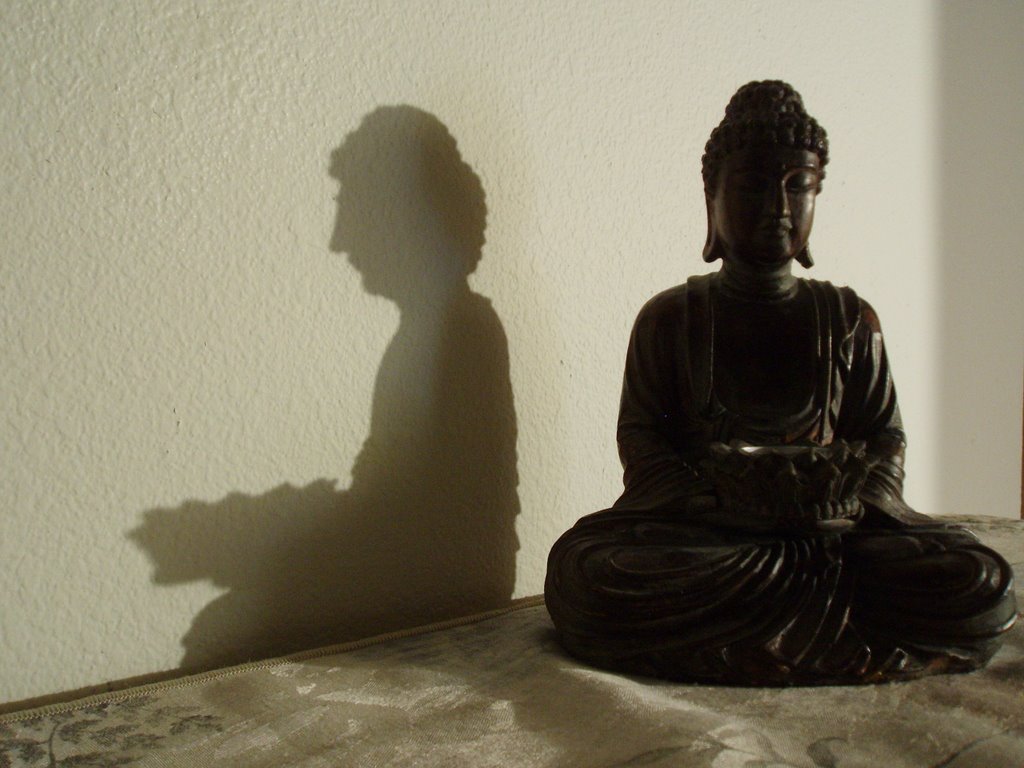
buddha and shadow (c) Kayar Silkenvoice
this is an audio post - click to play
For years, I've been told that I have a very interesting perspective on life, that my sensualism and my intense enjoyment of the beauty--the everyday sensual immediacy--of life is, if not unique, then unusually well-expressed.

I started this blog with the intention of making public some of these deeply personal written and photographic expressions, because the media is so overwhelming in its attention to, and expression of, the current of negativity running through the world right now. I wanted it to be an antidote.

For all the deeply personal information I've put here, I've tried to address various topics in such a way that anyone could relate to what I was saying. I've been seeking to express what I have in common with others, what all of us have in common--the universality of the human experience. I wanted to show everyone who read this blog to the beauty of their own existence. Reality beauty.

Life is so very beautiful. So very beautiful and so terrifyingly transient.

It is this transience I am addressing today.

I have a sister who is ill. Very very ill. And as her illness has progressed from acute to chronic, as she faces the prospect of a life radically different from the one she had just 9 months ago, she has lost the will to live. She is slowly dying. She is allowing herself to die in a very slow and excruciating way--and she denies it.

And I... I am caught in an ethical dilemma. It is easy for me to say that Life is beautiful. My life is beautiful. My world is beautiful. And it is all the more so for all the suffering I have experienced and witnessed. It is easy for me to be outraged with her for giving up. It is easy for me to urge her to keep trying. But her life is not mine.

My ethical dilemma is this: It is her life, and her choice, I know. But she is not making the choice consciously. She is in denial, both of the seriousness of her condition, and her apathy. And I am torn between respecting her wish--respecting her right to die--and my horror of the death she has chosen. I am being urged to do something more than I have been, to take extreme measures, to intervene. To Intervene.

There is a fine line between interference and intervention. When I ask myself, intellectually, what the difference is, I know it is a gray area. But my heart, oh, my heart knows the difference.

And so, I have grabbed the horns of my dilemma, and committed myself to an intervention that will earn me more verbal abuse and rage from her. I prefer her anger to her apathy. I prefer that she live.

I'm girding my loins to go into battle with a woman for her life. I'm not sure when I'll be able to post again, but I did not want those who follow this blog to continue to be concerned by my sudden silence.

Namaste.

Labels: , , , , , ,

Thursday, July 06, 2006

Reflections on Integrity and the Human Dilemma

Reflections, (C) KR SilkenvoiceLately I have been thinking about drive and ambition, purpose and resolve, and the confidence needed to support that resolve, and how integrity fits in there, between the drive of the ego to survive, to thrive, to achieve, and the conscience which tells me that it is of vital importance that I not hurt others in the process of getting what I want.

I recognize that my words, thoughts, deeds, and intentions create an environment that either supports or weakens my resolve. And whether it supports or weakens my resolve is dependent on my integrity, my ethics, my system of values. I am a person of conscience. And while I have few morals in the sense most people seem to, my values are very simple and I live in harmony with them: I do what makes me happy. And I try not to do what will make me unhappy.

Notice there is no undertone of fear. I lack fear with regards to my integrity/values because I am not a religious person. I do not have a 'faith' which dictates my ethical integrity. I do not allow myself that luxury: faith does not confront the questions of existence and how we respond to it; faith simply provides consolation and assurances that following a certain spiritual and moral road map is the answer to those questions.

There is not much that I invest 'belief' in because... in believing something, in taking it on faith in the absense of experientially substantiated fact, I close myself off to other things, one of which might actually be the truth. I refuse to believe in things that I cannot know. I neither affirm nor deny the existence of a god or gods, or an afterlife, or reincarnation, or a soul, or any of those Big Unknowables. Instead, self-honesty requires that I recognise what I do not know and I cannot know, and focusses me on what I can address: the human dilemma and the possible resolution of it.

And the human dilemma is this: at core, whether we choose to acknowledge it or not, we humans are are isolated, anxious creatures in a hostile world. Most of us experience ourselves as beings pitted against the rest of the world--just one more desperate soul struggling to survive amongst countless others. It is this desperation which puts us in conflict with our own integrity, I think. Desperation often drives us do or say things which hurt others and thus ourselves. Whether we admit it or not, we humans are empathetic beings in a participatory / shared reality, and we cannot hurt, abuse, or lie to others without diminishing our own Integrity, that law within. Thus the sense of conflict between survival and integrity. Thus the human dilemma.

And the possible resolution? Remembering that we have 'reality' in common. Remembering that we are more than just competitors for the 'better' things in life. Remembering that everything is transient: that we are all born, that we will all die, and that we will all suffer in between those two inescapable events. And lastly, realizing that as long as we fear the inevitability of suffering, we perpetuate it.

I think that most people don't realize that when we act with integrity, when we operate from a place of compassion and empathy for ourselves and each other, when we stop clinging to our fears of the undeniable and inescapable transience of life, we create a world with less suffering. Or at least, we are less likely to contribute to the fear and suffering. Ultimately, my integrity, and the integrity of my thoughts, words, intentions, and deeds, are based upon my sense of what I have in common with others, rather than what separates or distinguishes me from them.

The Internet, more than anything, has taught me that much.

Labels: , , , , , ,

Monday, May 22, 2006

Contemplating obstinacy

this is an audio post - click to play

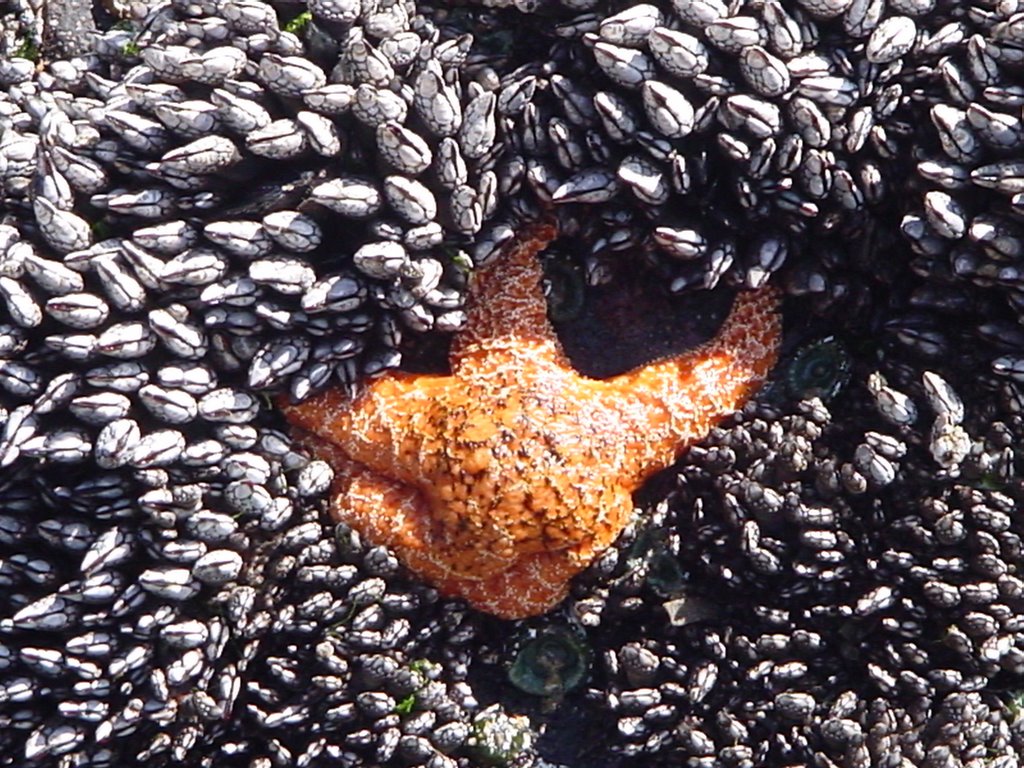
Starfish at Yahats, Oregon Tidepools (c) Kayar SilkenvoiceI've recently been contacted by someone through Literotica. An interesting man, who claims to be an editor, and who insists on calling me a writer, much to my chagrin. We had a bit of an argument about it, which he cut short by changing topics, I think becuase he felt that he, as one who edits writers, knows far better than I what one is. After our conversation ended, I went about making dinner, and as I ate it, thought about what we had discussed. And with a glass of wine in hand, I mailed him this:

You are not the only one who calls me a writer, if it is any consolation to you.

I do not know why I resist the label so. Perhaps it is a habit: I do not care for labels.

Or perhaps it is that writing comes too easily, or that I put so little effort into it. I mean really, I write what I think or feel or see or notice. There is no craft in that, no art, it is merely transcription.

And friends say to me, "Mozart and Beethoven merely transcribed the music playing in their heads. Does that make the label 'composer' less applicable? Does that lessen their genius?"

My answer is that I am no genius. Most days I feel like a fraud for being recognized for saying or writing things that simply 'are' to me. It is like saying Columbus discovered America. When I was a child I said: but it was always there! Why not recognize him for having the courage to test the theory that the world was not flat after all? Its not sexy, that is why.

I write about things that are sexy. Perhaps that is why people call me a writer? I do not know.

As for your feedback, also known as criticism, I welcome it. Truly. If nothing else it sheds light on the contrast between your perception of what a proper ending is, and my intuition that there are no endings, merely transitions from one moment, one state, to the next.

I recently wrote a poem called Compelling Question.
In it, I mention that another's consciousness is impenetrable. But it does not stop us from seeking to penetrate, to possess that other. Perhaps because I express my consciousness well, people find me more accessible, find the mystery of the other more accessible, and grasp at it. We are all so powerfully driven by the awareness, conscious or not, that we are alone, and not only that, but by the knowledge that the only certainty in life is that we will end, and we will end alone. And yet, there is a commonality, a universality to all experience, to all perceptions of reality, and in that, we are not alone. We find ourselves touched by the echoes of another's pain or self-awareness--their creative expression of it--and through it we can vicariously experience the other, or feel that they have experienced us, and know, for that moment, that we are not as alone as we felt. But people are not content to let the moment happen, and flow into the next, not if it means the possible loss of that shared consciousness. They do not want it to move on, and leave them solitary again. And so they cling to it, they close their hands about it, and forget the lesson of childhood: If you clutch the butterfly tightly in your hand so it will not fly away, you destroy the butterfly.

I think. Perhaps the better label is 'thinker'. I am a thinker. But applying that label to myself would seem vain, yes?

Better yet, call me a self-aware, self-conscious babbler.
That is a label I will not argue with :)

Kay
Starfish at Yahats, Oregon Tidepools (c) Kayar SilkenvoiceThe irony of the above is that it is written in response not only to him, but also to CD, my friend and mentor and ardent, loving admirer, who also calls me a writer, and whose encouragement on my writing I so roundly rejected this morning. Sorry, CD.

Labels: , , , , , , , , , , ,

Saturday, August 06, 2005

Contemplation at dawn

this is an audio post - click to play


I greeted the sun this morning after I dropped SP off at the airport. I went to my favorite spot to watch the sun rise over Mount Hood. It was a cool, refreshing morning, all the more sweet for knowledge of the heat to come. I spent several minutes practicing stillness, just breathing, listening to the sounds of an awakening world and savouring the splendid isolation of each moment as it blended into the next. I was moved to photograph the sight of morning mist flying the sun's colours, gentle herald of the light's upcoming triumph over darkness. I do so love that timeless moment before the sun crests the horizon, when I am swathed still in the embrace of night, and my eyes see anew the shapes of things, cast as they are into sharp relief.

Afterwards, as I drove home, I listened to the Sonata No. 1 for violin and piano by Camille Saint-Saens. I considered again the Philosopher Serf journal entry on a Herbert Marcuse quote, still formulating my thoughts on the way human beings recognize themselves in relation to what they own, and what they want. I thought about dawns and dusks, beginnings and endings, births and deaths, depletion and renewal, gain and loss, achievements and failures. I recognized that when I achieve something I have worked toward, I feel reborn.

And yet, as I grow comfortable with this feeling of renewal, something familiar arises: anxiety and fears are born from the ashes to which they were rendered by my triumph, success, acheivement, or acquisition. On occasion, my new possession or state loses lustre as something within me catches glimpse of the next thing I desire. Or more often, my joy is slowly tempered by a growing awareness of imperfection. Dissatisfaction thus creeps in, and sometimes anger, or pain, because that which I have attained has resolved nothing, it has only created the need to adapt to something 'new', with its oft unexpected complications. I try, I do so try, to accept that this is the nature of reality, that it flows and changes from moment to moment, that fearing what this mutability will bring is not only fruitless, but harmful to me.

In a moment of naked self-honesty, I asked myself why I had bound myself to this cycle of wishes fulfilled and wishes feared and wishes denied. Why can I not simply be pleased with my joys and my achievements, fully accepting and appreciating that life and everything in it is tragic, changeable, transient, cyclic, poignant, and occasionally, when I am lucky, joyful? Because I operate under the illusion that perfection is possible. That attaining what I desire will alleviate that pervasive sense of confusion, loss, and fear.

I recognize in myself that tendancy to feel that all I have gained and achieved is imperfect, insignificant, unworthy; thus my habitual rejection of abundance in my life. And so the cycle begins again, as I move on to the next new goal, or wander, listless and lost, overwhelmed with dissatisfaction, acheiving little more than a creative repetition of the past.

What I have and what I want are all the same, in the end. They have no intrinsic value in and of themselves, other than what I project onto them. They are merely projections of my longing to be free of the condition of suffering which we call "living."

[audio-entry]

Labels: , , , , , , , , , ,